

The Eden Project is a unique experience of the relationship we have with the world's eco-system of plants. Set in the abandoned remains of one of St Austells Clay Quarries, it includes the world's largest geodesic domes which contain two distinct environments; a jungle environment in the Humid Tropical Biome and a Warm Temperate Biome featuring Mediterranean, South African and Californian landscaping with its relevant plant species.


Although I don't usually have photos of people in my articles, I'm including this one of my sister and brother-in-law as they came over from Australia in 2003 for a holiday, and this was a visit to the Eden Project together, which we thoroughly enjoyed. I don't usually do tourist places either, but I think this one is definitely worth including and, as they have since sadly passed away, it's also a fitting memorial for them. :)

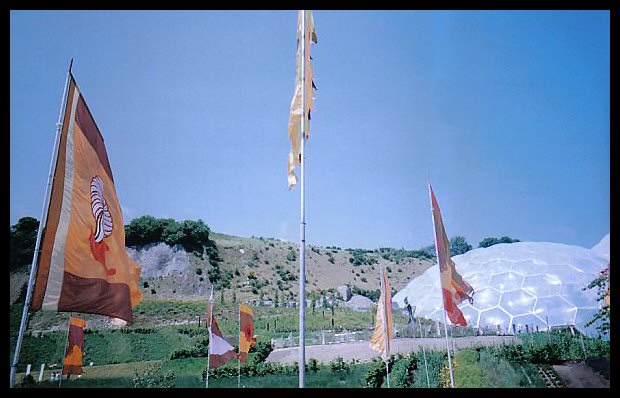
Extensive grounds surrounding the biomes include landscaped terraces and gardens. This is such a truly remarkable place and at the time we went there were these wonderful Tibetan style flags.


Looking at more recent photos online there are still flags with different designs - I think - but I can't find any close-up photos to check. I'm beginning to wonder if I'm the only one who likes the flags! ;)
There are also a lot more areas added to the grounds since. Even though it was much less extensive 21 years ago we still didn't manage to get around all the garden terraces as there was so much to see. Our first walk around was in the Humid Tropical Biome.

This hottest dome is very hot indeed. There are taps at frequent intervals to replenish the water lost through perspiring - which can be quite extensive - and there is an emergency hut for those who are overcome by the heat and taken ill. My other sister and her partner visited another time and he had to use the hut because of breathing problems due to the heat. If anyone plans to visit it's best to read all the literature first to see what you'll need to take with you, etc.

Huge Papyrus plants can be seen in the photo above. Usually to be seen gracefully edging the River Nile in Egypt, they look fantastic against the patterns of the geodome in the background.


An example of Indigenous artwork from Australia, below.

And the various usages of bamboo cane.


There was quite a steep path up through the dome, which also zapped the energy, but the view was incredible.


Then into the Warm Temperate Biome, which wasn't so overpowering, although still fairly hot.

Pigs and offspring made from driftwood rooting around a garden. Below is another garden setting either from the California or Mediterranean area.

Wonderfully quirky figures representing Greek Mythology.


The landscaping was full of Mediterranean plants, including olive trees and lavender.


Outside was a much cooler antidote to the biomes, even though it was a warm summer's day. We sat awhile with a cooling drink before setting out on a walk through the grounds. The Bee, below.


Hop bines can be seen below. An essential ingredient of beer. Mmm...beer!;)


And a fabulously mysterious sillouette further up the hillside.

For more information about the Eden Project there's a really good article on Wikipedia that covers all aspects of construction, contents, renewable energy and sustainable technology, new additions as well as future projects. Very well worth a read. Link here. :)
And finally the last photo I took was of this living sculpture covered in moss and grass titled 'Eve' against a background of crops in field portions.

I expect anyone who's visited in recent years can see quite a difference to how it was when we went and I'd be very interested to read any comments. :)
I wrote recently that there were many more articles to come but, having checked it out, I actually only have a handful of the former website ones to rewrite. These are the hard ones though, so I'm dragging my feet a bit. There are only a few new ones to do too, which means the end is in sight, but I should be able to pad them out with more of the other topics, such as Useful Books, etc.
On a happier note, I've changed a few things health management wise and am actually beginning to feel a lot better...more energy, motivation, and even walking a bit better too. It's a start anyway and maybe I can visit some more places again. We can but hope, lol.
Cheers 'til next time. :)


