Friday, 17 July 2020

Harris's Dairy, Seaton, Devon


I was once told, some forty or more years ago, that this building was originally a bakehouse. I hadn't found anything to contradict that when I wrote the article for my now defunct website. However, I've since discovered its true history, therefore I've changed the title to reflect that.


It's just around the corner from where I live, and I've always loved to see its state of decay and dereliction. There is something wonderfully photogenic of old wood, slate, stone and brick, together with wild flowers and ferns growing out from the stonework.


The small field, at the edge of which it sits, is usually fenced off, but the gate was open on this particular day. I happened to have my camera with me at the time, so it seemed rude not to take up the invitation! It isn't big or sensational; used as a storage/work shed, it looks similar to many 'long house' styles of outbuildings, which is quite typical of the East Devon area, but there is some interesting history, and I love the building for its wonderful idiosyncrasy.  
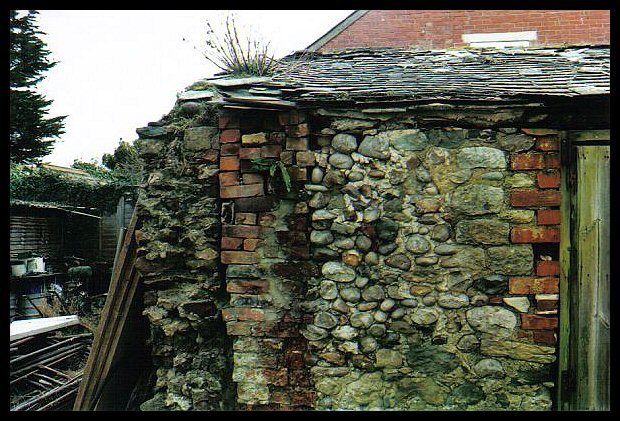


The above photo, along with a couple of the others, is also on the Pebble Buildings page. You can see why as this building is choc-a-bloc full of pebbles in the walls, along with a mixture of bricks, flint rubble and large stones.


Some time later, I saw the owner in the field and stopped to chat. I asked him about the history and told him what I'd been told about it. He said that it had never been a bakery, but only ever a dairy, and that the building next to it was used by Newenham's Repairs. 


Having looked at some old OS Maps I saw that this building was on the oldest map dated 1891. A house next door to the field entrance was also on there, written in as Eyewell Cottage (Eyewell Green being the road opposite) and both were surrounded by trees...possibly an orchard. On the later map of 1968 - 1973, Eyewell Cottage is now written as Elm Cottage; now called Elm House.


The field once belonged to a Nursery, as shown on the 1933 map. The term nursery referred to a plant nursery, where trees and plants were grown for sale or replanting elswhere. Nowadays the name is much less used and a local one - Otter Nurseries in Ottery St Mary - has just recently changed their name to Otter Garden Centres instead, reflecting the more common term now in use. The owner showed me the ridges in the field where the greenhouses once stood and they can be seen on the 1936 OS map.


A few years ago I took several on-line courses in Archaeology and in one of them we had a fun project concerning Stratigraphy. Instead of digging a trench we had to look out of the window and select a building to see how it developed by looking at its different layers. I cheated a bit and looked from my balcony where I could just about see this building...if I squeezed into the corner and leant over the railing, lol. It was such a good choice as there are so many additions and bits of patchwork, from old red brick, wood, pebbles, flint and rubble, to some breeze blocks blocking a window on the end by the road.


Taken from across the field (above) you can just about make out the wedge-shaped end of the building on the right side of the central houses. I was trying to get some details of those houses as it looks as though the outbuildings had been part of something else which had been partially demolished. The owner of the field, however, told me that they were built like that.  


A close-up from my balcony, showing the adjacent road opposite the old dairy and its shed at the bottom of the photo. And below, one showing the building from its entrance on the main road, with its breeze blocked window.


One of my favourite buildings. :)


Monday, 6 July 2020

The Masonic Hall & Good Shepherd Studio, Seaton, Devon


Similarly to the old Town Hall in Ottery St Mary, which now comprises the library, the Tourist Information Centre and the local newspaper, this is an excellent example of a building that has outlived its original purpose and has been divided up to accommodate other modern businesses and organisations.


This building was originally The Good Shepherd Church, built to serve a growing population and to provide for the elderly who had difficulty in attending the out of town parish church for evensong during the winter months. Built in 1889, at the cost of £1,250, in what was once called Sidmouth Street (now Queen Street), it eventually became redundant due to a dwinding congregation of churchgoers and was subsequently sold in the 1970s. The building was reorganised into three separate parts, the frontage belonging to the estate agents John Wood & Co, the above floor used by Anne Pengelly's stained glass studio (The Good Shepherd Studio), and the rear is now the Masonic Hall.


I had the opportunity to take some photos inside the Masonic Hall when the AGM meeting of the Axe Valley Heritage Society was once held there. The interior has been modernised, and is quite different to the exterior. However, there are a few interesting features, and it was lovely to see it lit up at night.


The gate below, with the masonic compass insignia.
 

I also made a daytime visit to the Good Shepherd Studio. I couldn't take many photographs whilst there, as a stained glass class was in progress, but just managed to take a few of the more accessible architectural features.


The front window, above, with the tiny round one above that and part of the wooden ceiling trusses. Below shows some details.


The Romanesque style side window below includes some of Anne's work attached to the original windows.


Anne very kindly showed me photos of the original church, below, which show the original front porch at the front...now replaced by the glass frontage of John Wood & Co.


And, a lovely surprise was that she designed and produced the stained glass insertion for the Masonic Hall, depicting the compass insignia together with the title De La Pole. De La Pole No 1181 is the name of the masonic lodge in Seaton and is probably in honour of the family of De La Pole who were once incumbent at Shute Manor.
 

And, just to finish off, here are a few more photos of the exterior.


Saturday, 20 June 2020

Town Hall & Seaton Museum, Seaton, Devon


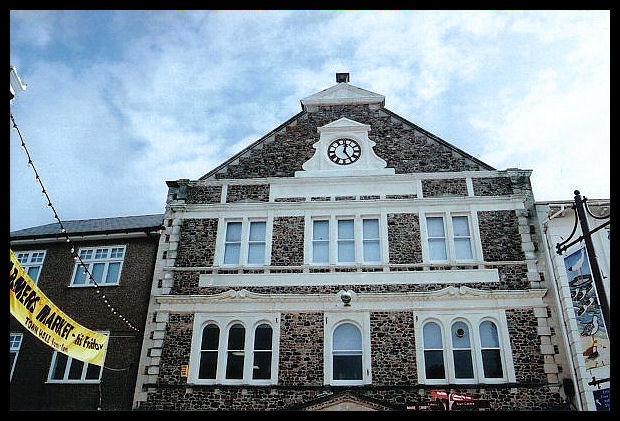
The long-time social centre of the town, Seaton Town Hall was opened on 27th July, 1904, and further extended during the 1930s. This lovely front elevation, however, is all that remains of its decorative past. Most of the building was destroyed during a fire on 22nd January 1945, leaving a shell, apart from the front offices and the rear caretaker's rooms. It was eventually rebuilt and subsequently reopened in 1952.


Constructed using a mixture of Beer Stone (a limestone specific to the quarries above the village of Beer) and an infill of chert, it's typical of many local buildings where these readily available materials have been utilized.


A few years ago, East Devon County Council had plans to sell the Town Hall - which was originally given to the people of Seaton - and which, quite rightly so, had everyone up in arms. This is one of those times when I wish I'd kept cuttings from the local newspaper, as I can't find anything now about the sequence of events. However, the outcome was that a group called Seaton Voice took over the running and management in partnership with the council, with the intention of eventually handing it back to the community by means of their Asset Management Transfer policy. Since then, there have been a huge amount of events hosted at the hall (now retitled The Gateway); tribute groups, other musicians, concerts, plays, films, shows, etc, and by all accounts they've been very well attended, many of them a complete sell out.


More community groups and facilities are also available, such as the Youth Cafe, Zumba Group and the Memory Cafe for residents with dementia, as well as long standing events such as the Christmas Bazaar, craft fayres and art exhibitions. One art event early in 2011 was a wonderful fun day with many artists and crafts practitioners holding demonstrations and allowing visitors to try their hand at making things.


As well as the main ground floor hall with bar and kitchen facilities, the first floor comprises a lounge and committee room for functions and training days. One of its many functions in the main hall was the monthly Farmer's Market (I'm not sure if that's still on-going). The photos below show plants and vegetables for sale.


The top floor houses the Seaton Museum, ran by volunteer stewards from the Axe Valley Heritage Association. An interesting array of displays and artefacts, it charts the local history from prehistoric times up to the last century, and is a great source of information for historians and serious students as well as a delight for visitors alike. Some of the Heritage Association's special events are also held in the Town Hall main room.


Although there are artefacts to be seen, Seaton Museum mostly contains photographs documenting people and events. Although I prefer things to people historically, the pictures are wonderful and give an amazing glimpse into times past.


There is also a very good timeline of Seaton from Prehistoric and through Roman times showing how certain industries and occupations came into being. The thing I love about history is how the landscape and actions upon it evolved; for instance, the Romans occupied the area, quarrying in the nearby village of Beer, which impacted upon successive generations in both Beer and Seaton.


Above, a case with lace making implements, which was an important industry amongst the women of Beer and Seaton. It's often called Honiton Lace but that's a bit of a misnomer, as Honiton was actually the nearest town on the highway to London where the lace was transported from, whereas the lace came from several towns and villages in East Devon as well as Honiton itself.


And smuggling was also an important part of the landscape. Above, a gorgeous spanish shawl brought back by a local smuggler. Not very clear unfortunately, due to the reflection of the large label in the glass showcase.


In this day and age of leisure facilities closing due to a bleak economic climate, this just goes to show how communities can pull together and create a vibrant social life for their own town. As Seaton Voice said on their website...ran by the people for the people. All in all, a fabulous success.


And finally, a photo taken from the top floor Museum, overlooking Cross Street and  Windsor Gardens.


I haven't edited this article too much from my original website edition - just enough to make sense on this later date and to correct a bit of grammar (a constant battle, lol) plus some more photos. However, I believe that both the Town Hall and Museum are closed at the moment due to the current pandemic conditions. Let's hope that things change soon and that people can safely enjoy events again. :)